
The North Pole: What’s It Really Like?
Have you ever wondered what it’s actually like to stand at the top of the world?
In this episode of I Wonder, 14-year-old Erika interviews adventurer Mark Hubner, who has trekked across the Arctic Ocean to the geographic North Pole. Hear about freezing temperatures, shifting ice, and the challenges of navigating this extreme environment — and hear how the North Pole is melting and disappearing faster than ever. Perfect for curious kids and the parents who listen along!
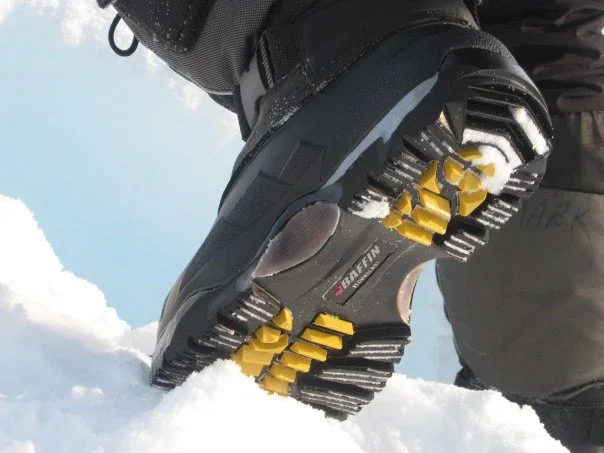
Episode sponsored by Baffin, the creators of technically advanced footwear and apparel for challenging cold climates.
Episode Transcript: The North Pole: What It’s Really Like?
Hey there, curious minds. Welcome to I Wonder, the show where we explore the big questions you've been wondering about. Today's question is a chilly one, and it was inspired by a listener all the way from the warm and sunny state of Florida. This listener asked, I Wonder what it would be like to visit the North Pole. What a great question.
The North Pole is one of those places most of us will only ever see on a map. It's remote, freezing, and incredibly hard to get to. So learning what it's really like to stand at the very top of the world isn't exactly easy. That's why this episode is extra special. We're not just going to talk about what makes the North Pole so unique. We're going to hear about it from someone who's actually been there. But before we dive into the interview, let's start with a quick overview.
Now, when we say North Pole, we don't mean the magnetic North Pole, the place that your compass points to. We're talking about the geographic North Pole. The exact point at 90 degrees north latitude where all lines of longitude meet. There's no land up there, no buildings, no penguins, they live all the way down south, and definitely no Starbucks. Just a massive sheet of floating sea ice drifting over the Arctic Ocean. The conditions are brutal. Temperatures can drop below minus 50 degrees Celsius. In the winter, there's complete darkness 24 hours a day. In the summer, the sun never sets. And because the ice is always moving, the spot you're standing on won't stay still, even if you do. That makes it tricky just to find the North Pole, let alone stay there.
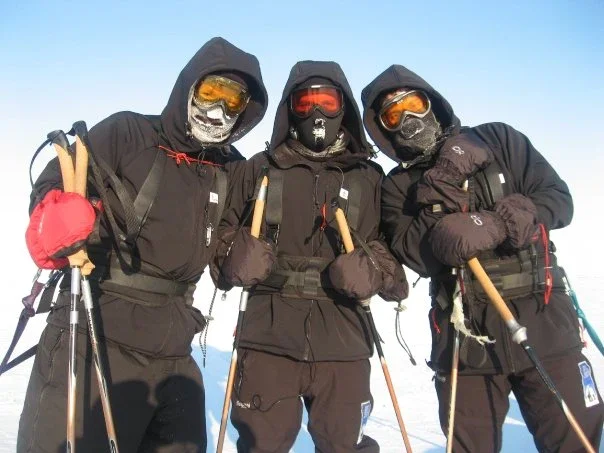
To give you a sense of how rare this is, only a few thousand people in all of human history have ever even made it to this icy drifting bullseye on top of the planet. It's cold, it's harsh, and it's a serious test of both gear and grit. Which brings us to our guest, Mark Hubner. Mark has trekked to the geographic North Pole, crossed the Arctic Circle on Baffin Island, and hiked some of the most unforgiving trails across the globe. He's faced whiteouts, freezing winds, and endless snow, and kept going when most people would have turned back.
And here's another surprise. He's about to be interviewed by someone just as cool. Erika, who's 14 years old and lives in Vancouver, BC. So get ready for a behind-the-scenes look at what it takes to visit one of the wildest places on Earth.
Here's Erika with her one-on-one interview with someone who stood at the top of the world.
Erika: Hi Mark, welcome to I Wonder. I still can't believe that you've actually been to the North Pole. Not many people can say that. So I have to ask, why? Did you just wake up one day and decide that you wanted to go to the North Pole?
Mark: Well, uh, I have to give credit where credit's due. And the trip was originally dreamed up by my father. He has always had a passion for the outdoors. He invited my brother and I to go along. And we grew up with a love for the outdoors and always appreciate the opportunity to set an adventurous goal and pursue it. So that's what inspired the trip.
Erika: Lots of people say that they're going to do things, but they never do. What gave you the final push to actually go?
Mark: It was an incredible opportunity and not one that I wanted to pass up. I was in university at the time, and you know, I had some of my friends tease me at some of the training methods along the way, such as dragging a tire around on pavement to mimic what it's like to pull the sled at the North Pole and then bring your gear along with you. But really what I've always found in ambitious goals is when we socialize a goal, we tell our friends, we tell our family, it really brings them to life. And you're that much more likely to achieve them.
Erika: Nice. I like that tip of sharing a goal with others in order to achieve it. Can you give us a visual? What did the North Pole actually look like?
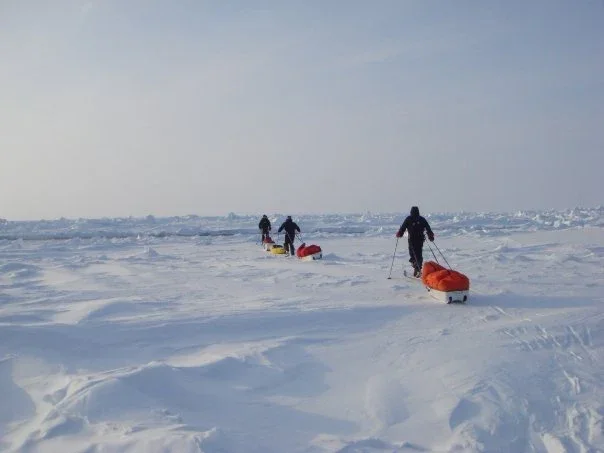
Mark: I would describe it almost as a frozen desert. The South Pole has been described as the white desert because it's actually on land. The North Pole isn't tremendously different in that there's white as far as the eye can see. While you are skiing across frozen ice and snow, you're actually at the same time floating on the ocean. Yeah. So the changes in terrain, you'll actually experience sometime something that's called the pressure ridges. And that's what happens when two sheets of ice will run into each other, and the pressure of that movement will build a ridge anywhere from six to ten feet in height of frozen chunks of ice and snow that you actually have to climb over and pull your sled over.
Erika: Wow. So the ice moves around. Did you ever feel it moving underneath you?
Mark: I never felt the ice actually moving, but I got very close to it. Uh I was climbing over a pressure ridge uh at one point, and my when when I thought my sled was secure and I was still ascending over the ridge, it slid back. And as it slid, it pulled me and I fell backwards. And I planted a pull to try and stop myself, and it snapped and I fell backwards. And when I looked down, I was essentially pushed between two blocks of ice just a few feet above the Arctic Ocean. And I could dip my glove in to the water, which was terrifyingly close. But that's why you do as much as you possibly can with a team. And I had a team of uh my brother and my father and a friend and Arctic guide with us who helped me out in that situation.
Erika: Yikes, I can't imagine how scary that must have been for you. Here's another thing I can't imagine. How cold is it actually in the North Pole?
Mark: Uh colder than I thought it would be. You know, we experienced temperatures from minus 40 to minus 50 degrees Celsius.
Erika: Minus 40? Whoa, that's cold.
Mark: What's probably coldest about the North Pole is the humidity. The moisture that's in the air makes minus 40 feel that much colder because when you're wet, you're cold and um it's cold.
Erika: Now that I know how cold it is, I'm not in a hurry to go. But let's say I wanted to go to the North Pole. How would you even start preparing for that?
Mark: There's a lot of logistics associated with it, as uh you may understand. Uh, so definitely start with a guide, somebody who's done it before. Uh they'll help you plan everything from getting to Norway and then up to an island called Svalbard. And from there, we actually took a plane that landed on an ice runway on the Arctic Ocean, where there is a uh science station set up for two months of the year, and they will help facilitate a trip where you can pursue the geographic north pole. So from that science station on the ice, we were then taken in a helicopter to a drop point. And from then on, we're on our own. So we would ski anywhere from seven to ten days. At times, you may actually get to the pole quicker because the ice will float you in the same direction. You could even overshoot it. You could also be on a treadmill where you ski for you know six hours and you end up further from the pole than you actually started out.
Erika: So very interesting. What do you think was the hardest part of your trip? Were there any moments where you're like, yep, time to go home?
Mark: Yeah. So for me, the hardest part was actually on the last day of the trip. We were told that we were probably about a 45 minute ski from the pole. And that's where we would finish the trip and set up camp and wait to get picked up. Now, I found that to be the coldest part of the entire trip. Now, with 45 minutes left, I thought to myself, well, I can probably just push through and get there. So I didn't, I didn't drink water, I didn't have, you know, some soup that we had made that morning. I didn't have any snacks. I thought, it's just 45 more minutes and I'll get there. 45 minutes passed. And we looked and we still had probably another 45 minutes to go. When you're in those elements, when it's that cold, you're exerting that much energy. It is critically important to fuel yourself, to consume calories, to drink liquids and stay hydrated. And I made the mistake of not doing that even proactively. So I ended up skiing for several hours in an extremely cold and challenging environment without fueling myself in any way. I grabbed my dad and they said, I have to stop. And my I couldn't feel my hands. And um, I said I hadn't eaten or had anything to drink because I thought we'd be there by now. So I sat down on my sled and he unscrewed a thermos and gave me some some warm soup. And it was the only time in my life that I've actually felt something, you know, go into my body, down into my stomach, and return warmth to my extremities. And I started feeling my fingers again as I was drinking and consuming calories, and that's how close I came to being uh in a pretty critical state, which for me was the scariest moment.
Erika: Wow, that sounds really scary. Were there any other dangerous situations?
Mark: Aside from uh pressure ridges, the other thing that we uh in have to deal with and encounter is something called open water leads. So when the Arctic ice separates, it will reveal the Arctic Ocean beneath it. We actually had a kayak with us. So we dragged an empty kayak uh over the course of the trip and our sleds could flow. So when we'd encounter an open water lead, we'd tie all the sleds together and we'd shuttle them across, and then we'd, you know, use rope and straps to shuttle kayak back and forth. Now, while we were getting ourselves and our gear across, the ice was separating faster and faster. And what started out as being a very narrow crossing of water became, you know, as wide as somebody's house. I I actually was able to take a pretty cool picture of him on the other side of this open water lead. And as the ice was widening, and I grabbed all the straps and all the ropes that we had left, and we still had a bit of slack, and I knew we'd clip them all together to get him to safety, but I didn't take that moment. And I don't know if he was as excited about the photon as I was at the time, but uh we can laugh about it now.
Erika: Was there lots of times you had to travel across the water in a kayak or only a couple?
Mark: Only a few times. Yeah, all right. We encountered more pressure ridges than we did open water leads, but you know, I'll share something that is a little disheartening. This trip was almost 20 years ago. And at the time, there were some open water leads, but not many. Uh a few, a few years ago, uh I was working with a partner of ours to to return to the Arctic. And I actually heard from the teams that were up there and they had to cancel the North Pole expedition season. And the reason was was there was too much open water. And it's not very long before the trips that we've done and have been done recently will not just, you know, miss a season or two. They will just no longer be possible because when that ice melts, uh, I guess the alternative would just be to kayak to the North Pole. But I don't think we can ski there for much longer.
Erika: I know when I do hard things, I learn a lot about myself. What did you learn about yourself on this journey?
Mark: I chose not to start the trip with any music at the time. I could have taken an iPod with me, for example. And my fear was that it would run out of batteries or freeze, and I didn't want to have been enjoying and dependent on music. Uh, so I I guess I I learned that I can spend a lot more time alone with my own thoughts than I thought I could.
Erika: What advice do you have for other young explorers who are listening to this show?
Mark: Exploration and adventure is everywhere, it is all around us. Some of the most fun adventures and explorations that I've had have come in my own backyard. And there is no trip too big or too small to find adventure and exploration. And I try to incorporate that into you know any weekday or or weekend opportunity of adventure that I have.
Erika: Well, that's some good advice. Well, Mark, that is all we have time for today. Thank you so much for being here and sharing your story with us. It sure was an adventure.
Wow! What an incredible story! Huge thanks to Mark Hubner for giving us a front row seat to what it's really like to stand at the top of the world. And another big shout out to Erica from Vancouver for doing such a great job in the interview.
Before we go, here's a heads up about our next episode of I Wonder. We're exploring what it's like to be an extreme athlete, and we're joined by none other than Connor Emony, the first person ever to compete an iron distance trianthlon on all seven continents. Talk about pushing limits. If you have a question you've been wondering about, don't forget to submit it on our website, iwonderpodcast.com.
Stay curious and see you next time on I Wonder.